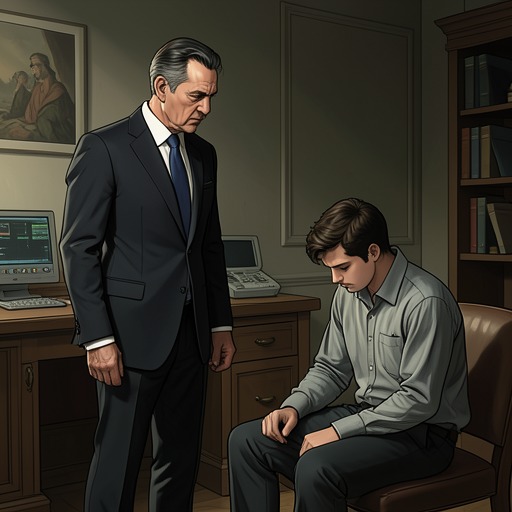
Willie Keith and His Father, Dr. Keith
The Caine Mutiny Court-MartialWillie Keith and His Father, Dr. Keith is defined in this episode by a parting message that joins paternal affection to an expectation of purposeful work. A Bible sent from the hospital reaches Willie aboard the USS Caine with a handwritten note directing him to Ecclesiastes 9:10. Dr. Keith presents the verse as his last word to his son, then makes its relevance explicit: it is about Willie’s job on the ship. Willie receives the counsel not as abstract instruction but as a deeply affecting charge, and shortly afterward chooses duty over a social invitation.
The gift arrives aboard ship
The moment begins amid the ordinary business of mail call. On the quarterdeck in the twilight, sailors gather around the mail orderly as he calls names and distributes letters and packages; four dirty, weather-stained canvas sacks lie at his feet. Willie takes his mail aft to the gloomy clipping shack, where Harding remarks that Willie’s family had expected him to go straight to the Caine. The scene’s crowded, workaday setting makes the battered package stand out: it is a private message arriving within the impersonal routine of shipboard life.
Among old, crumpled letters from May and his mother, Willie finds an oblong package that looks like a book. His father’s handwriting shocks him. He tears the package open and discovers a black-bound Bible with a wrinkled note protruding from it. The worn appearance of the parcel and the note’s intimate placement make the gift feel less like a formal bequest than a message deliberately sent for Willie to find and read. The letter has crossed from the hospital into his life aboard ship, connecting the father’s circumstances to the son’s new responsibilities without bringing them together in person.
A farewell made practical
Dr. Keith’s note describes the immediate facts plainly: he is writing while sitting up in bed, and the operation is scheduled for the following day. He names the surgeon, Dr. Nostrand, and admits that he appreciates the surgeon’s optimism too readily. The restrained wording holds hope and apprehension together. Dr. Keith does not offer Willie reassurance that the outcome will be favorable; instead, he acknowledges his own eagerness to believe in optimism while preparing to leave his son what he calls his last word.
That last word is Ecclesiastes 9:10: “Whatsoever thy hand findeth to do, do it with thy might; for there is no work, nor device, nor knowledge, nor wisdom, in the grave, whither thou goest.” Dr. Keith has underlined the passage with wavering ink lines. In the broad margin he adds a personal gloss: “He’s talking about your job on the Caine, Willie. Good luck.” The verse’s general injunction thus becomes specific paternal advice. His father connects the urgency of finite life to the work Willie has actually been given, making the Bible both a farewell gift and a standard by which to approach that work.
Willie’s response to his father
The scene records Willie’s reception through physical gestures rather than an extended spoken exchange. He turns to the passage with shaking hands. After reading his father’s marginal note, he switches off the light, throws himself onto his bunk, and buries his face in the sooty pillow. He remains motionless for a long while, indifferent to the creases forming in his last shore-laundered khakis. The contrast between the carefully preserved words in the Bible and the dirt and worn clothing around him gives the message a place in his immediate shipboard reality; his grief is registered in the stillness of a young officer alone with the gift.
The father-son relationship is therefore conveyed through a compact sequence of acts: Dr. Keith sends the Bible, selects a passage, marks it, and explains its bearing on Willie’s work; Willie reads, absorbs the message, and withdraws into silence. The father’s voice reaches him through handwriting rather than conversation, yet the note is unusually direct about what it asks. It does not merely bless Willie in general terms. It names the Caine as the place where he must put the verse into practice.
Duty as the answer to the message
The personal moment is interrupted when an orderly from the admiral’s staff reaches into the shack and touches Willie’s arm. The admiral’s barge is at the gangway for him. Willie raises himself on one elbow, covers his eyes with his hand, and asks the orderly to tell the admiral that he is sorry but cannot come because he has duty. He then drops his face back into the pillow. The invitation presents a choice between an evening engagement and an obligation aboard ship; Willie’s answer is brief, but it gives the father’s counsel an immediate practical echo.
The narrative does not state that Willie declines the reception in conscious obedience to the verse, so the connection is best understood through sequence and juxtaposition. First, Dr. Keith directs him to do his work with all his might and identifies that work as his job on the Caine. Then Willie, still visibly overcome by the letter, turns down the reception on the ground that he has duty. The next morning, Lieutenant Commander Philip Francis Queeg reports aboard. Against that transition, the episode makes the father’s message a point of departure for Willie’s shipboard service: an intimate farewell becomes a standard attached to the work he is about to undertake.